

I was as excited about Jev as anyone. I built Jev Pong in an afternoon, a general model making a decision every few hundred milliseconds for next to nothing and with no training, and the post I wrote about it did better than anything I’ve put out in years. I run Ably, so my interest is the latency rather than the cost. I’ll admit that up front, and you should read the rest of this with it in mind.
Then people started asking the obvious question, and I’d been asking it myself. Great, you built a game. Now what?
I said I’d follow up with real use cases. This is that follow-up, and it isn’t the one I expected to write.
I started where I always start, which is our customers. Chat, live events, agents talking to people. Where would Jev go? Moderation, obviously. Every chat product needs it and a cheap model that can judge a message before it lands sounds perfect, right up until you think about who does moderation for a living. The specialist providers understand harm across languages and cultures, they run review queues and appeals, they rate limit, they deal with the regulator. The probability that comes out of a model is the easy part of that system. The model was never the problem.
Trading was next, and it was the worst of my ideas. Not fast enough for anyone who trades at speed, not accurate enough for anyone who trades for real. Games I’d already done. It’s fun to build stuff and I do it because it demonstrates something, but what I built was a demo, and if you were building an actual game engine you’d train a model for it and beat Jev on latency and cost both.
I kept hitting the same wall. Every idea I came up with in the hundred to three hundred millisecond range, which is where human interaction sits and the range I care about, turned out to be either a solved problem or a much bigger problem than a cheaper model.
So I stopped guessing and looked outward. There’s a feed of every Jev post, so I took its first week, 5,950 posts, had a model label each one against a written rubric, had a second model audit 1,681 of them blind, then read what the two public gateways publish and counted the rivals. I used agents for the sorting and I’ve published the labels, so if you think they’re wrong you can re-grade them yourself. The full report is at mattheworiordan.github.io/jev-landscape.
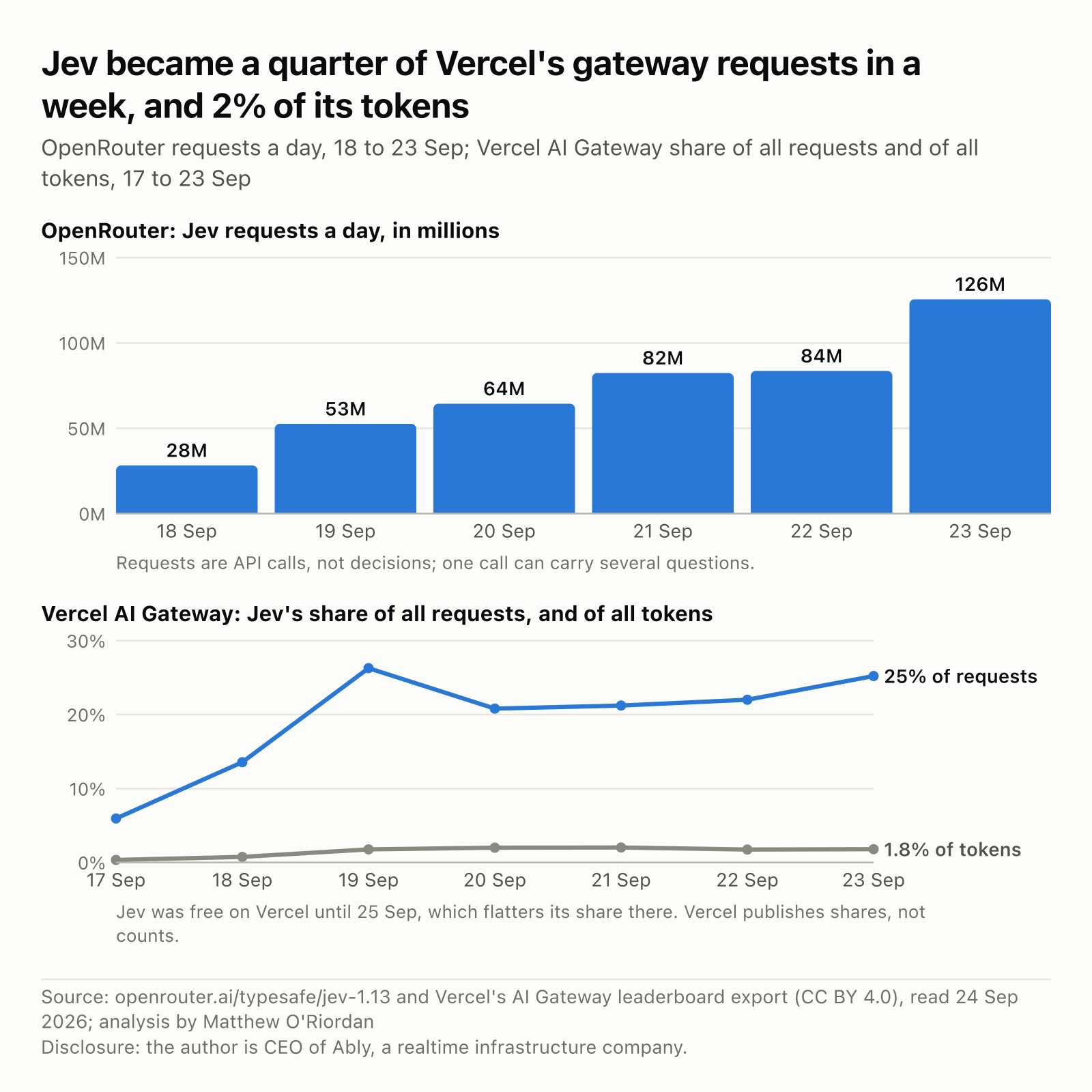
Jev on the two public gateways in its first week, from the report.
Adoption is very real. On 23 September Jev was a quarter of all requests going through Vercel’s AI Gateway. It was also 2% of the tokens. On OpenRouter it did more requests that week than GPT-5.6 Luna, for about an eighth of the money, and 96% of that traffic came from apps that don’t say who they are. An enormous number of tiny calls, then, and almost nobody able to say what they’re for. I’m struggling to separate people trying it out from people who’ll still be running it in a month, and to be open about it, the data can’t settle that yet either. Another fortnight of gateway numbers will say more than I can.
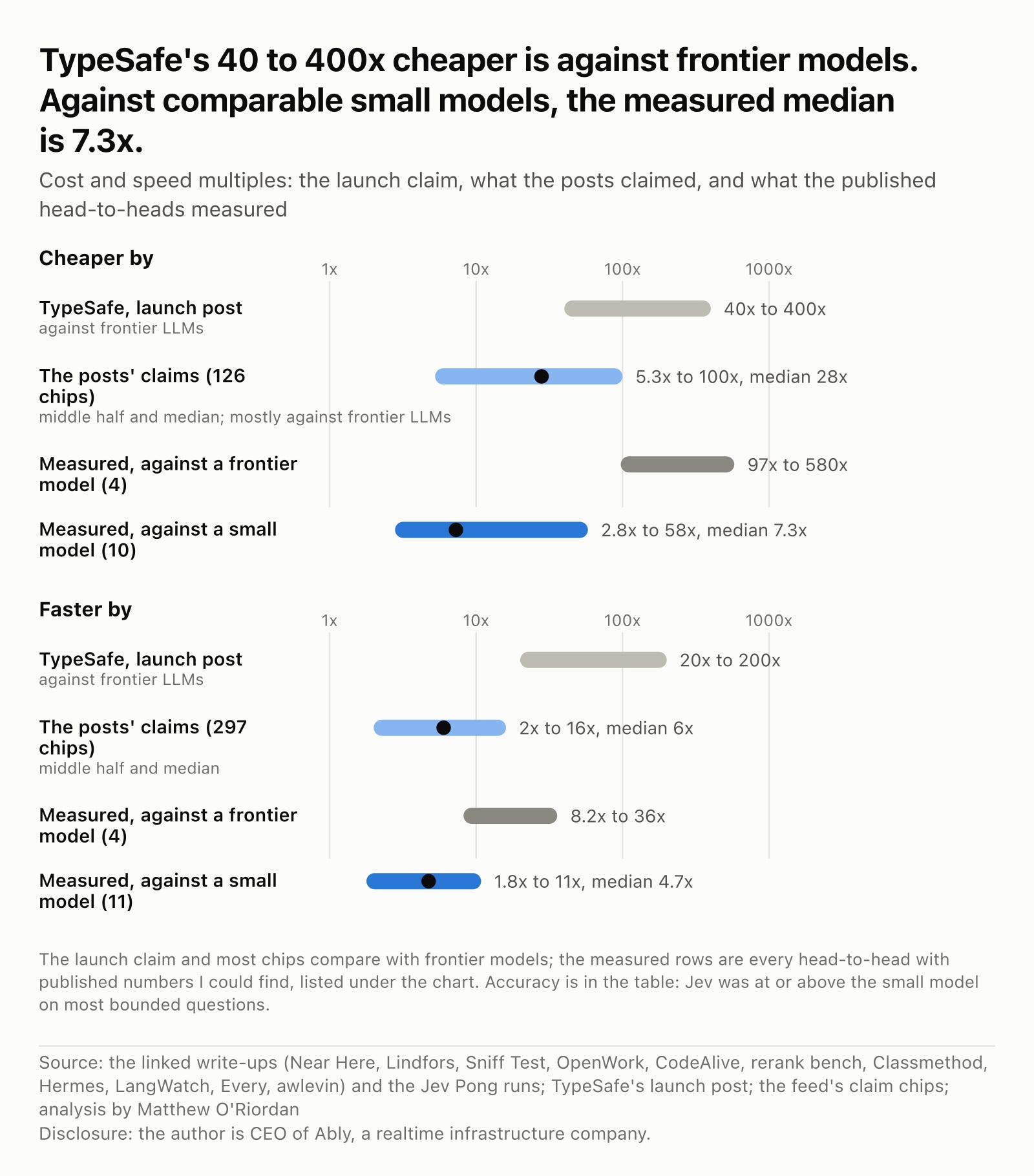
What TypeSafe announced, what people claimed, and what anyone measured, from the report.
Then there’s the 100x. TypeSafe’s launch claim was 40 to 400 times cheaper and 20 to 200 times faster, and against frontier models it holds. But nobody sensible sends a yes or no question to a frontier model. Compare Jev with the small models you’d actually use for that job and the published head-to-heads put the median at about 7x on cost and 5x on latency, and in most of those tests the accuracy was as good or better. That’s worth having. It isn’t a new category of software though. Laya is already out there on open weights, and you’ve always been able to train your own, which is what people have done for years and what Tobi Lütke keeps showing is getting cheaper by the month.
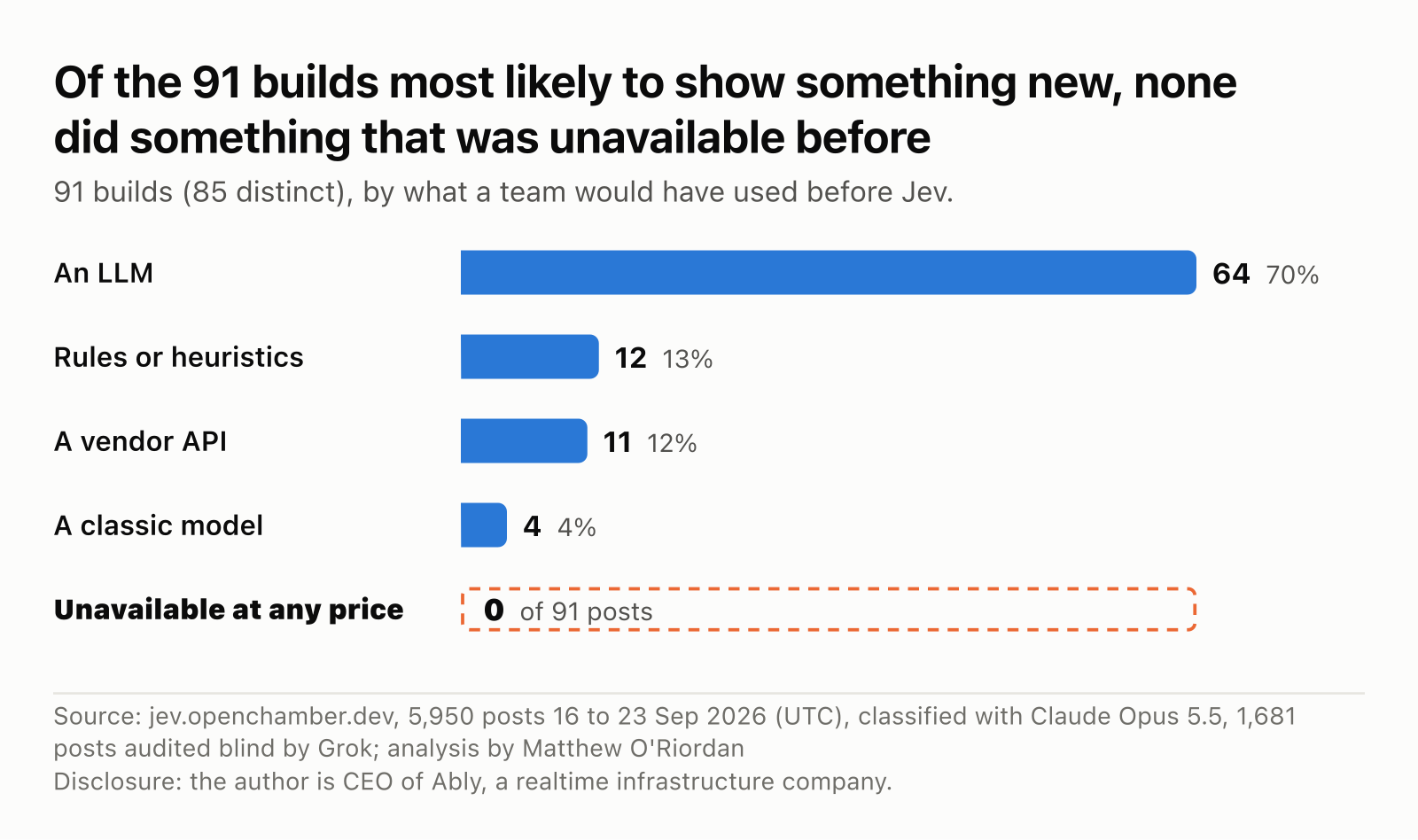
The 91 builds most likely to show something new, and what would have done the job before Jev, from the report.
This is the bit that changed my mind. Four in five posts compared Jev with nothing at all. So I took the 91 builds with the best chance of showing something genuinely new, the ones where somebody measured a decision in a live system with a person waiting on it, and asked what would have done the job before Jev existed. An LLM did 64 of them. Rules did 12. A vendor API did 11. Not one of the 91 was something you couldn’t do before. It was cheaper and faster at things we already did.
Twenty rivals turned up in the same week, which I hadn’t expected either. One was trained by agents in twenty hours on a single GPU for about three thousand dollars. One is a Shopify engineer’s side project. None of them matches Jev on cost, speed and accuracy together yet. But if that’s the moat, it isn’t a big one.
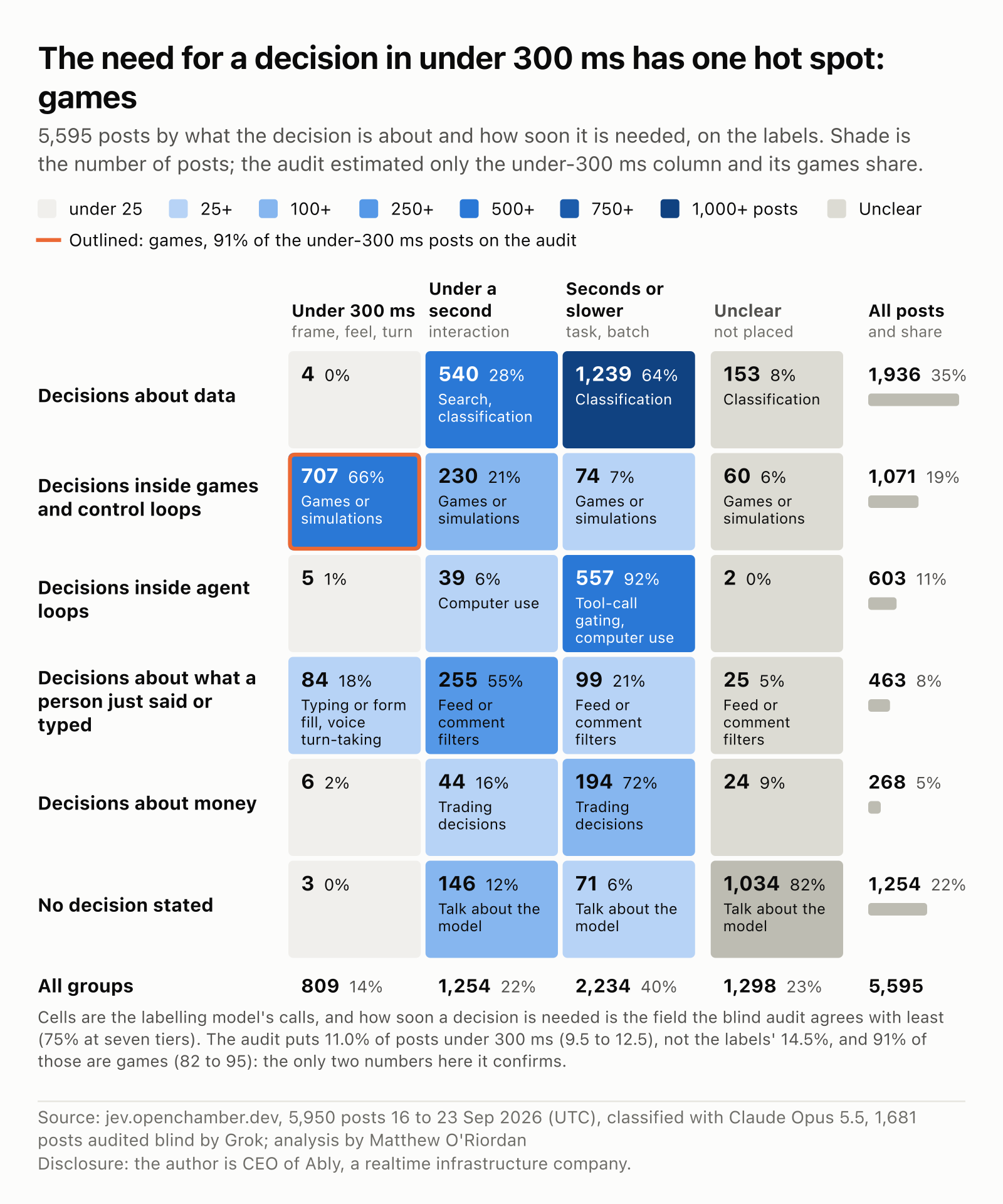
Where people built, against how soon the decision is needed, from the report. The cells are the labeling model’s calls. The audit confirmed the games numbers: 11% of posts need a decision under 300 ms, and 91% of those are games.
Put it all together and the sweet spot is far narrower than it looks. If you want the speed, you’re really talking about games, where decisions have to keep up with frames. The cases I was hoping for, a voice agent deciding whether it’s its turn to speak, or a chat message held for a beat so something can check it before it lands, or a person taking over from an agent mid-conversation, are 4% of what got built and none of it is measured in production. Everything else is classification. Cheap classification is useful, but if you do it at scale you’ve had a classifier for years, and if you don’t, a small LLM was already cheap enough.
So where does that leave Jev? Built for tinkerers, and I mean that as a compliment. Generalized intelligence at low latency and low cost, with no training, in an afternoon. That’s real. It didn’t exist for most of us a month ago and it’s brilliant for prototypes, PoCs and the narrow jobs where you genuinely need a general model to decide something quickly. It’s just a lot narrower than the hype, and a lot narrower than I thought two weeks ago.
My bet is that it doesn’t last. The open-weights specialists are already here, training keeps getting cheaper, and I’d expect one of the frontier labs to ship something like a Haiku designed for decisions before long. When that happens I don’t think Jev the product survives. Jev the idea does, and I’m glad it happened, because it has made a lot of us think about what a decision should cost and how fast it should come back.
Think I’ve got this wrong? The data’s open (github.com/mattheworiordan/jev-landscape published at mattheworiordan.github.io/jev-landscape). Tell me.